Christmas Pop-out Card Laser Cut Holiday: A Practical Guide for Creators
In the realm of digital crafting, few assets offer as much immediate visual impact as a well-designed three-dimensional greeting card. The Christmas Pop-out Card Laser Cut Holiday file set represents a specific category of digital resources designed to bridge the gap between flat vector art and tangible, mechanical engineering. For professionals, small business owners, and serious hobbyists utilizing laser cutting technology, this type of asset is not merely a decorative image; it is a functional blueprint for creating complex, interlocking paper structures that transform when opened.
The value of this specific digital product lies in its precision and versatility. Unlike standard print-and-cut templates, which rely on scissors or die-cutting machines with limited depth capabilities, a dedicated laser cut file allows for intricate scoring, partial cuts, and deep kerf adjustments. This enables the creation of 3D Christmas ornaments, pop-up presents, and elaborate winter holiday scenes that stand out in a market saturated with mass-produced cards. Whether you are producing custom gifts for corporate clients, stocking your Etsy shop for the festive season, or simply elevating your personal holiday correspondence, understanding the mechanics and application of these files is essential for success.
Technical Specifications and File Compatibility
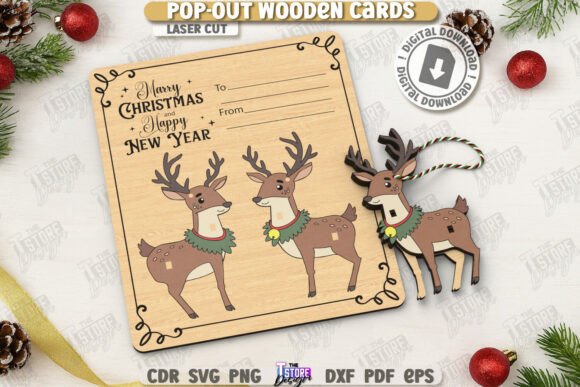
The utility of any digital design asset hinges on its file formats and how they interact with industry-standard software. The Christmas Pop-out Card Laser Cut Holiday package typically includes a comprehensive suite of files: one SVG (Scalable Vector Graphics), one EPS (Encapsulated PostScript), one PNG with transparency, one PDF, and one DXF (Drawing Exchange Format). Each format serves a distinct purpose within a professional workflow.
For designers working within Adobe Illustrator or CorelDRAW, the EPS and SVG files provide the necessary scalability without loss of resolution. These vector formats allow for easy customization of text, color fills, and minor geometric adjustments before sending the job to the machine. However, the most critical component for actual production is often the DXF file. While SVG is widely supported, it can sometimes introduce dimensional inaccuracies depending on the slicing software used.
A notable consideration for users operating Lightburn, a popular interface for laser engravers and cutters, is the potential for distortion when importing SVG files. Lightburn has been known to misinterpret certain coordinate systems or scaling factors inherent in some SVG exports, leading to parts that do not fit together correctly. In such scenarios, the included DXF file becomes indispensable. DXF is a robust, neutral data format that preserves geometric integrity across different CAD and CAM platforms. By prioritizing the DXF file for Lightburn users, the risk of misalignment—where tabs fail to slot into pockets or layers sit unevenly—is significantly reduced.
Evaluating Design Quality and Structural Integrity
When assessing the quality of a Christmas Pop-out Card Laser Cut Holiday template, one must look beyond the aesthetic appeal of the preview images. The true test of a good design is its structural logic. A high-quality pop-up card relies on precise tab widths, accurate fold lines, and balanced weight distribution. If the tabs are too thin, the mechanism will tear under the stress of opening and closing. If they are too thick, the card may not close flush or may require excessive force to operate.
Effective designs in this category account for the "kerf"—the width of material removed by the laser beam. A professional-grade file set will either include kerf compensation or be designed with enough tolerance to accommodate standard wood or chipboard thicknesses. This attention to detail ensures that the final assembly is rigid and durable. When the card is closed, it should lie flat; when opened, the 3D elements, such as Christmas trees, ornaments, or wrapped presents, should rise smoothly without warping the base structure.
Furthermore, the inclusion of a transparent PNG file offers significant value for mockups and marketing materials. Entrepreneurs selling these cards can use the PNG to create realistic product listings without needing to physically manufacture every variation immediately. This accelerates the time-to-market for new seasonal products, allowing creators to showcase their vision to customers before committing to material costs.
Real-World Applications and Market Potential
The practical applications for the Christmas Pop-out Card Laser Cut Holiday extend far beyond simple home crafting. For small business owners, these files represent a low-overhead entry point into the premium gift market. The perceived value of a handmade, laser-cut 3D card is substantially higher than a printed flat card, allowing for better profit margins. These items are particularly effective as:
- Corporate Holiday Gifts: Companies seeking unique, memorable tokens of appreciation for employees or clients often prefer customized items over generic swag.
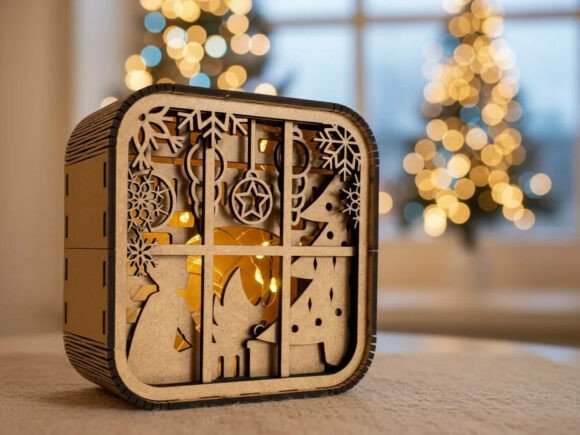
- Special Occasion Greetings: Beyond Christmas, the structural principles apply to other holidays, though this specific set focuses on Xmas themes like snowflakes, stockings, and family gatherings.
- Decorative Ornaments: With slight modifications to the mounting points, the same pop-up mechanisms can be adapted to hang as 3D window decorations or tree ornaments.
For educators and workshop leaders, these files serve as excellent teaching tools for introducing concepts of geometry, spatial reasoning, and digital fabrication. Students can learn about vector paths, nesting strategies to minimize waste, and the physics of folding mechanisms. The hands-on nature of assembling the card reinforces the connection between digital design and physical reality.
Workflow Optimization and Material Selection
To maximize the effectiveness of the Christmas Pop-out Card Laser Cut Holiday, selecting the appropriate material is just as important as choosing the right file format. While the files are scalable, the thickness of the stock dictates the final outcome. Standard 60lb to 80lb cardstock is ideal for delicate, multi-layered pop-ups where flexibility is required. For sturdier, more permanent ornaments, basswood or birch plywood ranging from 1/16 inch to 1/8 inch provides a robust alternative.
When setting up the job in your cutting software, it is crucial to organize the layers efficiently. Nesting multiple copies of the design on a single sheet reduces material waste and increases production speed. However, care must be taken to ensure that moving parts are not nested too closely, as the heat from the laser can warp adjacent sections. Using a perforation mode for fold lines rather than a full cut is a technique that enhances the longevity of the card, preventing the creases from snapping after repeated use.
It is also worth noting that while the provided files cover the primary needs, specific projects may require variations in size or color. The creator of these assets acknowledges this flexibility, offering support for custom requests. If a specific project demands a larger scale for a display piece or a different resolution for high-definition printing, direct communication with the seller can facilitate these adjustments. This level of support adds a layer of reliability to the purchase, ensuring that the resource remains adaptable to evolving project requirements.
Limitations and Considerations
Despite its strengths, the Christmas Pop-out Card Laser Cut Holiday is not a universal solution. It requires access to a laser cutter and the technical proficiency to operate one safely. Beginners may find the setup process, particularly regarding focus height and power settings, challenging. Additionally, the complexity of the design means that assembly requires patience and fine motor skills. Rushing the gluing or fitting process can result in a finished product that lacks the intended symmetry or stability.
Another limitation is the dependency on software compatibility. As mentioned earlier, not all slicing software handles vector files identically. Users relying on proprietary or older software versions may encounter import errors. It is always advisable to test a small section of the design on scrap material before committing to a full batch of expensive stock. This "test cut" phase is non-negotiable for maintaining professional standards and avoiding costly mistakes.
Conclusion
The Christmas Pop-out Card Laser Cut Holiday file set stands out as a valuable resource for those invested in digital fabrication and seasonal gifting. Its strength lies in the combination of versatile file formats, specifically the inclusion of DXF for reliable laser cutting, and a design philosophy that prioritizes structural integrity. While it demands a certain level of technical skill and equipment, the return on investment—in terms of product quality, customer satisfaction, and creative fulfillment—is substantial.
For professionals looking to expand their portfolio with high-end, customizable holiday items, this asset provides a solid foundation. By adhering to best practices in file management, material selection, and machine calibration, users can produce consistent, high-quality results that distinguish their work in a competitive market. Whether used for commercial ventures or personal projects, the ability to transform a digital file into a stunning 3D object makes this resource a worthwhile addition to any creator's toolkit.